This is probably my first real post to any blog anywhere! I wanted to keep it short and sweet, but I tend to go a little overboard when it comes to writing, so please bear with me (this pun made more sense when I thought I’d use Bear Blog for my host!).
I’m a graphics engineer who has spent most of his career in tech so far, where I had the convenient (but totally illegitimate) excuse of “the company doesn’t allow its employees to publish personal software projects online” to procrastinate on anything non-work related. But I recently made a big career change over to the games industry, and I figured that now is a better time than ever to break my laziness streak! So I hope to mostly talk about code projects here, probably related to graphics and games, but one of the best parts of doing something new is that you can go in any direction, and it will still feel new, so who knows how this will turn out!
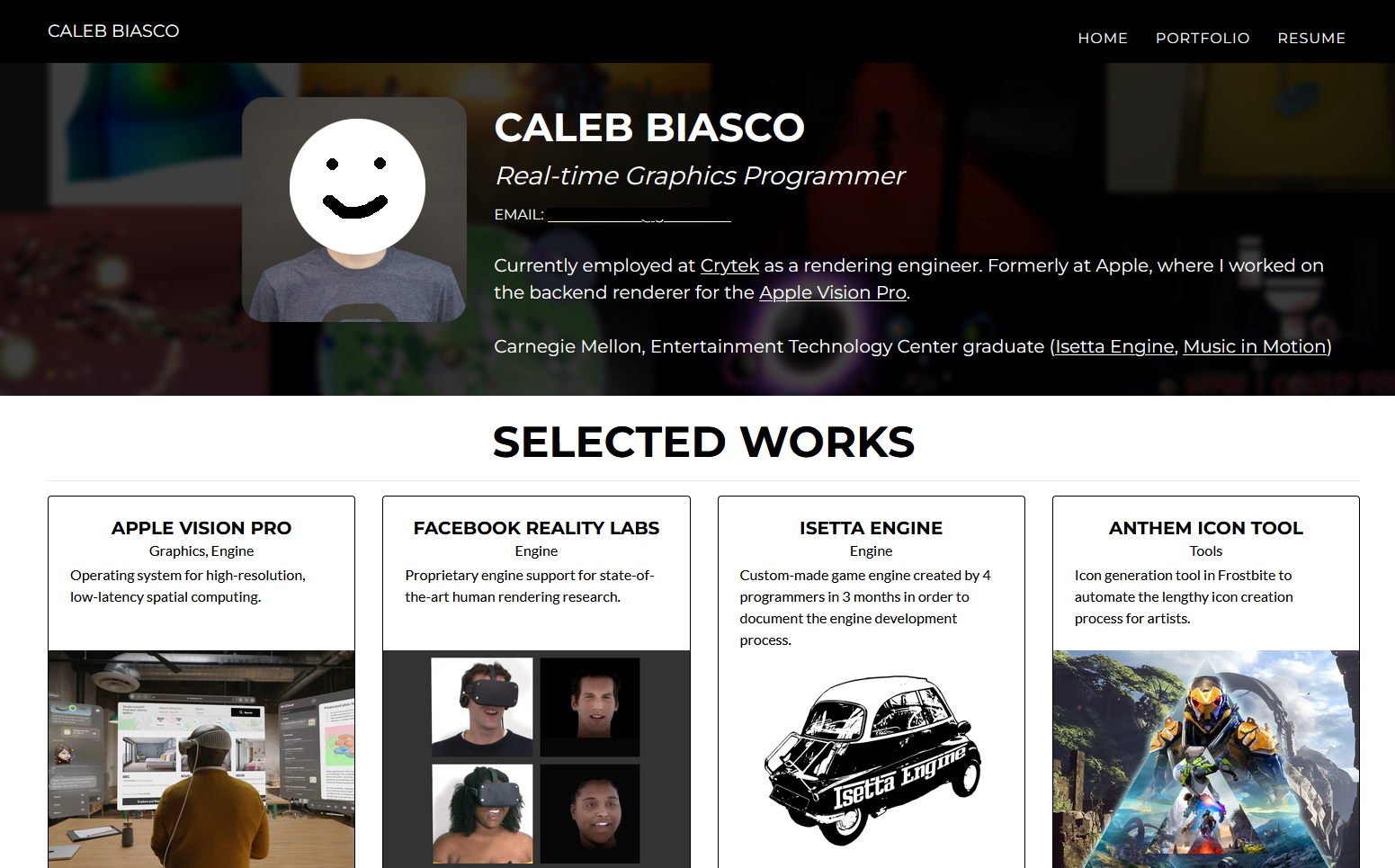
An old website of mine using https://getbootstrap.com/
For this first post, I just want to talk about my process for picking a blog host. I already have a (soon-to-be-deprecated) website, but it was built for job hunting and with much less of a minimalist streak than I have now, which is why I’m looking for greener pastures. Now, I’m the type of person to indulge in “analysis paralysis” when it comes to any decision that involves any sort of commitment whatsoever, so it should come as no surprise that I opened about 20 tabs worth of webpages as soon as I decided I wanted to write a blog. With my main interest being graphics, I’ll want a good way to integrate images, videos, and code into the posts, but as with most software, the world is really our oyster when it comes to what’s possible.
I obviously didn’t invent the idea of blogging about graphics stuff, so I decided to take a look at a few examples that I’ve enjoyed over the years to see if any features from their websites stood out:
Bear Blog
Bear Blog is a super simplified blog host that focuses on its consistency and robustness over feature richness or monetization. On top of that, Bear Blog has qualities that made it a great “low-commitment” choice: it’s free-ish and is super easy to set up, it has all of the basic building blocks for cutting one’s teeth on blog writing, and it seems to follow some tenets that I personally endorse, such as building long-lasting software.
I actually gave this a try before going with my current host, mainly because of the “analysis paralysis” topic. Of all of the things that I’ve learned so far in my career, one of the most important is the truth behind the word “commitment”. There are times when committing to something legitimately deserves great caution, but those things tend to be a bit obvious – for example, a work contract. In 99% of the non-obvious cases though, the amount of effort needed to undo a commitment is so low that it’s not worth more than a minute of thought, and “which blog service should I use” for sure fits into that bucket. And given that I switched to another option within a week of choosing it, I’d say that wasn’t a bad idea!
The ryg blog (Fabian Giesen)
Fabian uses WordPress, one of the old hats when it comes to web hosting. I had the experience of working in WordPress about a decade ago, and while I’ll always be impressed by the sheer technical depth that Fabian puts into his posts, I imagine he may still be dealing with the WYSIWYG clunkiness that software from WordPress’s era tends to carry with them. Aside from that, it also has a pretty busy layout, and I’m interested in being as lightweight and to the point as I can manage.
Inigo Quilez’s blog
Since Inigo has been a staple resource for graphics on the web for many years, I imagine that his site has organically grown into what it is today. Considering that it’s more of an encyclopedia than a blog at this point, it makes sense that it would be very customized (although aside from embedded ShaderToy programs, it’s mostly just images and Markdown). But my priorities are in getting my thoughts down on digital paper and pushed out into the world, so I imagine I won’t need the level of usability that Inigo’s site strives for.
Bartosz Ciechanowski’s blog
On the surface, Bartosz’s website seems a little more cookie cutter than Inigo’s, looking like something you could get from any blog service. But as soon as you dig into any of his posts, it’s obvious that it may be the most high-tech blog in existence! Even beyond the highly interactive and beautiful renderings, his text styling and how it matches the illustrations is *chef’s kiss*. I frankly might send him an email just to ask if he uses any tools for constructing his blog posts, or if it’s by hand… In any case, while this feels like a gold standard to aspire to, I also recognize that it requires an extraordinary amount of experience and design expertise, so I think it’s in my better interest to opt for a more constrained blog service. At least for now.
The Danger Zone (Matt Pettineo)
Matt uses a self-hosted Hugo instance, with the Hermit style. The result is a super clean and pretty lightweight site that is as customizable as anything else on the web, even including embedded JavaScript. It also includes comments, which can be great for extending the discussion on topics. However, a peek behind the curtain at his hosting repo reminded me of exactly why I grew to dislike hosting my own website: CSS, yaml, doc generators, HTML… But my previous experience with maintaining a self-hosted website may allow me to avoid the biggest pitfalls with this option.
There were a couple others that I took a look at (Jeremy Ong, Bart Wronski), but they were mostly just different flavors of one of the options I listed above.
What I went with
If you happen to just read the footer of my website (unless I’ve since changed it), you’ll notice that I went with Hugo. Ultimately, Bear Blog was just a bit too limiting in its design for me, and the fact that I’d have to pay a few bucks to remove those limitations made it a bit more of a “commitment” in a sense. Hugo, on the other hand, clearly shows a lot of flexibility, even if it comes with some upfront maintenance cost. In fact, Matt wrote a great article on how he switched from WordPress to Hugo, which enlightened me to some great solutions for more advanced features like comment hosting, which made Hugo also seem like the best long-term option.
That’s it! Hopefully I stick with this whole blogging thing, but in case I don’t, there are plenty of folks who do just fine in filling the void of 1s and 0s that is the internet – like those mentioned above!